Blog

Cairo Sumner High School “Red Devils”

Cairo Sumner HS Front View 2014
A picture containing grass, sky, outdoor, building

Description automatically generated
Photo by Monsignor Richard Soseman
Inscription Above School Entrance
A picture containing text

Description automatically generated
Photo by Monsignor Richard Soseman (left click on photo for larger view)
Cairo Sumner High School
A picture containing building, outdoor, grass

Description automatically generated
Photo Courtesy of Howard Thomas

The History of Cairo Sumner High School

Cairo (population 3,632) is located in the farthest southern tip of Illinois in the farthest southern portion of Alexander County. Cairo is located at the junction where the Mississippi River meets the Ohio River. U.S. Route 51 is the main roadway leading to and from Cairo. Interstate Highway 57 travels by the northwest side of town. Illinois Routes 3 and 37 lead the way from Cairo to the north. The Illinois Central Gulf and Conrail railroads lay tracks through Cairo as well.

An excellent history of Cairo can be found on the Wikipedia website page address of  http://en.wikipedia.org/wiki/Cairo,_Illinois. This site explains the history of Cairo as follows:

“Cairo was founded in 1837 by the Cairo City and Canal Company, after an earlier effort (1818) had failed, and incorporated as a city in 1858. For fifteen years the town grew slowly, but the sale of lots, which commenced in 1853, and the completion of the Illinois Central Railroad attracted settlers, with the result that by 1860 the population exceeded 2,000. It was an important steamboat port in the nineteenth century; Cairo even had its own Customs House, which has since been converted into a museum. During the American Civil War Cairo was of great strategic importance and for several months both Grant and Foote had headquarters there. The town has a number of fine examples of prosperous nineteenth-century and early twentieth-century architecture — much of it abandoned and in a bad state of decay. ”

The city of Cairo reached its population peak of 15,000 residents in the early 1900’s. However, slowly but surely the city never reached its early projected status. Its population has declined steadily to its current 3,600 person status.

Cairo was also a very segregated city in its early days. The residents of Cairo supported two public high schools. Cairo Sumner was built specifically for the African American residents.

Sumner HS Memorial Plaque
Text

Description automatically generated
Photo by Monsignor Richard Soseman

Dave Sanders researched and located the following information about Sumner High School:

“In a report on Cairo schools, the Normal Gazette (Carbondale, IL) of January, 1890, states that attendance was poor at “the Sumner buildings” due to “high sipe water.” (Sipe water is water saturating the ground due to high river levels.)

According to the book “On Jordan’s banks: emancipation and its aftermath in the Ohio River Valley” by Darrel E. Bigham, Sumner High School graduated its first class in 1893.”

Sumner HS Side View
A picture containing sky, grass, outdoor, building

Description automatically generated
Photo by Monsignor Richard Soseman (left click on photo for larger view)
Cairo Sumner HS Side View
A picture containing grass, sky, outdoor, building

Description automatically generated
Photo by Monsignor Richard Soseman (left click on photo for larger view)

The high school building pictured above was built in 1927. The original Cairo Sumner HS building was located at 18th and Walnut and was built just after the Civil War.

Changing times and turmoil of the 1960’s led to the abolition of segregated schools in America. Cairo Sumner High School was closed in 1967. All students of Cairo would now attend the only public school left in Cairo, Cairo Community High School.

The Cairo Sumner High School building still stands today. Portions of the building are currently being used by the Shawnee Development Council. The building houses an Outreach Office, as well as a branch of the Illinois Employment and Training Center.

The following information regarding Sumner High School was sent to us by Dave Haberkorn:

Address: 2201 Poplar Street. Enrollment: 238 (in 66-67 Illinois coaches directory).

Colors: Maroon, White.  Nickname: Red Devils.

Sports offered: football, basketball, baseball and track.

Cairo High School Class of 1967 -Last Senior Class
A group of men in military uniforms

Description automatically generated with low confidence
Submitted by Wendell Purchase (http://wendellpurchase.com/)

Cairo Sumner High School Quick Facts

Year opened:                                           late 1800s (first graduating class – 1893)

Year closed:                                            1967

Consolidated to:                                      Cairo Community High School

Sumner HS team nickname:                     the “Red Devils”

Sumner HS team colors:                          Maroon & White

School Fight Song:                                  unavailable

Athletics

We know that Sumner High School had some success in the IHSA tourney in the sport of boys’ basketball and boys’ track (www.ihsa.org). Due to research conducted by Dave Haberkorn, we know the school competed in baseball and football as well. Sumner was a member of the Southern Illinois Conference of Colored High Schools (SICCHS) with a total of 21 other schools between 1919-1948Team records, coaches’ names, and school fight song are all items we are seeking.

Boys Basketball

The Sumner Red Devils won two District titles in their history. The titles occured fairly close together. Unfortunately, coaches’ names and team records of these and other great Sumner HS teams are not currently available.

We are told that Coach C.K. Cole led the Red Devil hardwood court men in the late 1950’s and early 1960’s, in fact he coached Sumner HS athletes for about 30 years! Though we are not certain of the exact years, Coach Cole led the boys basketball program to an overall record of 429-123 while at the helm. This places Coach Cole at number 121 on the list of most coaching wins in a career in IHSA history! Coach Cole spent his entire career at Cairo Sumner High coaching the Red Devils.

One Cairo fan added this information on the Cairo basketball program:

“The School had a long and illustrious history, for the record C.K. Cole coached at Sumner for more than 30 years, with his tenure interupted by WWII he served as a officer in the war. Sumner played a highly competitve schedule in the days prior to 1960. The teams frequently played Wendell Phillips and Dunbar high schools from Chicago, East St. Louis Lincoln High School was an annual combatant until 1969, Memphis Hamilton High, Frederick Douglass and Booker T. Washington of Tulsa and Oklahoma City and well as Vashon and Sumner high schools of St. Louis, Missouri were frequent foes.”

1924-25                  SICCHS Champions

1928-29                  SICCHS Champions         Coach Lenal Mason

1929-30                  SICCHS Champions         Coach Lenal Mason

1930-31                  SICCHS Champions         Coach Lenal Mason

1931-32                  SICCHS Champions         Coach Lenal Mason        

1932-33  Postseason scores, record, and coach’s name needed.

1933-34  Postseason scores, record, and coach’s name needed.

1934-35  Postseason scores, record, and coach’s name needed.

1935-36    19 – 5                                                Coach C.K. Cole

1936-37    16 – 2                                                Coach C.K. Cole

1937-38    20 – 3                                                Coach C.K. Cole

1938-39    12 – 13                                              Coach C.K. Cole

1939-40    15 – 8                                                Coach C.K. Cole

1940-41    19 – 6                                                Coach C.K. Cole


1941-42  Postseason scores, record, and coach’s name needed

.

1942-43  Postseason scores & record needed. Coach H.B. Pierce


1943-44  Postseason scores & record needed. Coach H.B. Pierce

Cairo Sumner Basketball Team of 1943-44
A group of people posing for a photo

Description automatically generated with medium confidence
Submitted By Wendell Purchase

1944-45  Postseason scores, record, and coach’s name needed.

1945-46  Postseason scores, record, and coach’s name needed.

1945-46     9 – 9     Carbondale District Tournament     Coach C.K. Cole

1st Rd Beat Brookport Lincoln

                               Semi-final lost to Mounds Douglass 51-35

Douglass Beat Carbondale Attucks in title game

1946-47   16 – 10    Cairo District Tournament              Coach C.K. Cole

1st Rd Beat Brookport Lincoln 54-21

                               Semi-final lost to Mound City Lovejoy 53-36

Douglass Beat Lovejoy in title game

1947-48   18 – 6      Carbondale District Champions Coach C.K. Cole

1st Rd Beat Colp 60-26

                               Semi-final Beat Mounds Douglass 49-39

                               Title Game Beat Carbondale Attucks 48-34

                               Harrisburg Regional Tournament

                               1st Rd lost to Carrier Mills 53-51

Marion beat Harrisburg in title game

CARRIER MILLS (53): Beggs 15, Travelstead 11, Lail 8, Pritchett 7, Osburn 6, Durfee 6.

CAIRO SUMNER (51): B. Bondurant 13, White 10, Goodman 9, Brooks 8, Tyler 6, Brown 3, E. Bondurant 2.

1948-49   15 – 8      Mounds District Runner-Up        Coach C.K. Cole

Semi-final Beat Colp 51-39

                               Title Game lost to Carbondale Attucks 41-39

1949-50   15 – 7      Cairo District Champions            Coach C.K. Cole

Early Rd Scores Needed

Title Game Beat Mounds Douglass 52-47

                               Lawrenceville Regional Tournament

1st Rd lost to Hutsonville 46-41

Lawrenceville Beat Brookport in title game

1950-51   18 – 4      Mounds District Runner-Up         Coach C.K. Cole

Semi-final Beat Brookport Lincoln 80-47

                               Title Game lost to Mounds Douglass 57-50

1951-52   14 – 8      Mounds District Runner-Up         Coach C.K. Cole

Semi-final Beat Colp 51-39

                               Title Game lost to Mounds Douglass 64-36

1952-53   20 – 4      Cairo District Runner-Up              Coach C.K. Cole

Semi-final Beat Mound City Lovejoy 67-61

                               Title Game lost to Mounds Douglass 84-74

1953-54   16 – 6      Postseason scores needed.            Coach C.K. Cole

1954-55   14 – 10    Postseason scores needed.            Coach C.K. Cole

1955-56   11 – 11    Palestine District Tournament         Coach C.K. Cole

1st Rd lost to Palestine 77-53

Allendale beat Hutsonville in title game

1956-57   15 – 9      Palestine District Tournament          Coach C.K. Cole

1st Rd lost to St. Francisville 78-60

Allendale beat Palestine in title game

1957-58   13 – 10    Palestine District Tournament          Coach C.K. Cole

1st Rd lost to Palestine 70-46

Hutsonville beat Palestine in title game

1958-59   16 – 8      Hutsonville District Tournament       Coach C.K. Cole

1st Rd lost to Noble 59-52

Hutsonville beat Noble in title game

1959-60   10 – 14   Cairo Sumner District Champs      Coach C.K. Cole

 Semi-final Beat Dietrich 58-45

                               Title Game Beat Hutsonville 71-43

                               Anna Regional Runner-Up

                               1st Rd Beat Cairo 88-52

                               Semi-final Beat Wolf Lake 52-46

                               Title Game lost to Mounds Douglass 77-74

MOUNDS DOUGLASS (77): Beckom 23, Childress 22, Madison 13, Clark 10, Smith 8, King 1.

CAIRO SUMNER (74): Wood 24, Solomon 15, Ferguson 15, Rush 11, White 7, Patton 2.

1960-61   11 – 10   Mounds District Runner-Up           Coach C.K. Cole

1st Rd Beat Hutsonville 49-36

Semi-final Beat Dietrich 50-41

                              Title Game lost to Allendale 55-45

1961-62   16 – 8     Cairo Sumner District Champs      Coach C.K. Cole

 1st Rd Beat Allendale 60-50

 Semi-final Beat Dietrich 64-61

                               Title Game Beat Hutsonville 66-47

                               Olney Regional Runner-Up

                               1st Rd Beat Robinson 54-52

                               Semi-final lost to Olney 54-48

Bridgeport beat Olney in title game

1962-63   14 – 8     Cairo Sumner District Tournament    Coach C.K. Cole

Semi-final lost to Noble 50-39

Noble beat Dietrich in title game

1963-64   21 – 4     Hutsonville District Runner-Up      Coach C.K. Cole

Early Rd Scores Needed

Title Game lost to Dietrich 58-44

1964-65   16 – 5     Allendale District Tournament            Coach C.K. Cole

 1st Rd Beat Allendale 63-42

Semi-final lost to Dietrich 70-57

                               Title Game Dietrich beat Noble

1965-66    18 – 5     Hutsonville District Tournament          Coach C.K. Cole

1st Rd lost to Allendale 92-61

St. Francisville beat Noble in title game

1966-67    13 – 12  Cairo Sumner District Tournament      Coach C.K. Cole

                               1st Rd Beat Hutsonville 63-60

                               **Semi-final lost to lost to Allendale 79-54

St. Francisville beat Allendale in title game

**Final game for Cairo Sumner High School basketball, school consolidated to Cairo High School in the summer of 1967.

*Great Player – Oris Hill, Sr., a graduate of Cairo Sumner High School, played for the Harlem Globetrotters in the 1940’s and 50’s.

Coach C.K. Cole, Cairo Sumner High School
A person in a suit

Description automatically generated with low confidence

*Great Coach – C.K. Cole

Head basketball coach from 1935-36 through 1940-41 and from 1945-46 through 1966-67.

Coach Cole was inducted into the Illinois Basketball Coaches’ Association Hall of Fame in 1974. The IBCA Hall of Fame write-up reads as follows:

“C.K. Cole was a 28 year coaching veteran at Cairo Sumner High School where his teams compiled a 429-213 record for a 66.8% of games won.  Coach Cole has received many awards in recognition of his outstanding coaching achievements.  His team experienced only two losing seasons in a most remarkable career.  Coach Cole also coached football, track, and baseball.  He enjoyed similar successes as a head coach in these sports as well.”

Thank you to Robert Mason for sharing this information!


Boys Track & Field

Three District titles, six SICCHS championships, and an INDIVIDUAL STATE CHAMPION hi-lited the Sumner High School tracksters’ successes. JOSEPH IVY was crowned the STATE CHAMPION in the 440 Yard Dash in 1944-45! The school also won the SICCHS title in the spring of 1931.

1929-30              SICCHS Champions    Coach Lenal Mason

1930-31              SICCHS Champions    Coach Lenal Mason

1931-32              District Champions      Coach Lenal Mason

                         SICCHS Champions

1936-37              SICCHS Co-Champs   

1938-39              District Champions

                          SICCHS Champions


1940-41              District Champions

                          SICCHS Champions

1944-45              Individual Medalist

                         JOSEPH  IVY     440 Yard Dash    STATE CHAMPION!!!

1966-67                                                  Coach F.W. Wood

Football

1965    1 – 4   Coach C.K. Cole

1966              Coach C.K. Cole

Baseball

1966-67          Coach C.K. Cole

Memories

**From Wendell Purchase (Class f 1967):

“My uncle, Hardy Pierce, taught shop in 1943-44 and was the high school basketball coach.  At my website (www.wendellpurchase.com) you will find a page on SUMNER HIGH SCHOOL.  Most of my 13 brothers and sisters graduated from SUMNER.  I graduated from Sumner in 1967, the final graduating class.

There are photos of Sumner H.S. from 1943-44, and a copy of the last graduating class in 1967.  I am the light skinned young man in the middle in the top row.”

Need Your Assistance

If you have any information to share regarding the history of Cairo Sumner High School please write to us at ihsgdwebsite@comcast.net. We hope to record the history of this unique school along with the many successes those who supported and attended there attained. You can also write to us at:

Illinois HS Glory Days

6439 N. Neva St.

Chicago, Il.        60631

Cairo Sumner Class of 1944
A group of people posing for a photo

Description automatically generated with medium confidence
Submitted by Wendell Purchase (http://wendellpurchase.com/)
Sumner HS Rear View
A picture containing building, outdoor, sky, brick

Description automatically generated
Photo by Monsignor Richard Soseman (left click on photo for larger view)
Cairo City HIstory Plaque
A close-up of a circuit board

Description automatically generated with low confidence
Photo by Monsignor Richard Soseman


Cairo St. Joseph High School “Fighting Irish”

Cairo St. Joseph High School
A black and white photo of a building with a clock on it

Description automatically generated with low confidence
Cairo St. Joseph Grade School 2014
A picture containing grass, outdoor, sky, tree

Description automatically generated
Photo by Monsignor Richard Soseman

The History of Cairo St. Joseph High School

Cairo (population 3,632) is located in the farthest southern tip of Illinois in the farthest southern portion of Alexander County. Cairo is located at the junction where the Mississippi River meets the Ohio River.  U.S. Route 51 is the main roadway leading to and from Cairo.  Interstate Highway 57 travels by the northwest side of town.  Illinois Routes 3 and 37 lead the way from Cairo to the north.  The Illinois Central Gulf and Conrail railroads lay tracks through Cairo as well.

Cairo has a very rich and storied history in the early settlement of the United States.  Cairo’s location along the Ohio and MIssissippi Rivers made it an important city during the Civil War.  Cairo serves as the County Seat of Alexander County.  It was incorporated in 1858 and is the lowest land point in Illinois sitting at 279 feet above sea level.

The early 1900s served as the true “boom” time in Cairo.  The population was at an all-time high of over 15,000 residents.  The need for higher education was forseen by the Catholic church.  In 1916 St. Joseph High School was established in Cairo. The school was managed by the School Sisters of Notre Dame. St. Joseph High served the parishoners and students of Cairo for 46 years.

The following information and memories of St. Joseph High School was provided to us by Joe Profilet, Class of 1949:

“I attended St. Joseph High School from 1945 until graduating in 1949. There were only 9 of us in the graduating class. This was a litle smaller than the average class in those days, but there were never more than about 50-55 students in the whole higih school.

As you noted in your article, the school was manned by the School Sisters of Notre Dame. There were 4 rooms on the second floor of the building pictute that housed the high school. Each room had a nun as a home room teacher. The school required 4 years of English (grammar and rhetoric), general mathematics, algebra I and II, geometry and trigonometry.

There were courses in chemistry and physics and general science. And naturally each semester there was a course in the Catechism of the Catholic Faith.

During many years in the 40’s until its closing the school was run by Fr. Rudolph Jantzen who was the superintendent. One nun served as the principle.

On the bottom floor of the school were 4 class rooms. Each held two classes of the elementary school. One nun taught both years: 1-2, 3-4, 5-6, and 7-8. There was no kindergarten class

The High School boys basketball team was coached by Coach Jimmie Darrow. Jimmie was not otherwise employed by the school. It was a volunteer job. Jimmie otherwise was employed in others jobs. One was as a clerk in a sporting goods store in downtown Cairo. He also worked at one time at Woodward Hardware, a wholesale company located in Cairo.

The high school boys basketball team, as you know, was named the Fighting Irish. This was kind of humorous looking back on it, since St. Josephs was the “German” Catholic Church in town. The Irish parish, was St. Patricks. The St. Pat’s kids did come to St. Josephs for High School, since that parish only had a grammar school. Not all of the St. Pat’s kids went on to St. Joe High, but went on to the public Cairo High School.”

Along with the steadily decreasing population trend in Cairo came a steadily decreasing student population.  St. Joseph High School was effected by this trend and had dipped to an enrollment of 45 students in 1952 for grades 9 – 12.  The decision was made to close St. Joseph High School. Having no other parochial school in the area, the Cairo St. Joseph students would attend Cairo High School to continue their education.

Cairo St. Joseph High School Quick Facts

Year opened:                                         1916

Year closed:                                          1952

Enrollment Final Year:                             45 students (Grades 9 – 12)

St. Joseph HS team nickname:                the “Fighting Irish”

St. Joseph HS team colors:                     Blue & Gold

School Fight Song:                                 “Cheer, Cheer to Old St. Joe High”

                                                                                  Notre Dame University Fight Song Tune

Cairo St. Joseph Gym / Auditorium
A picture containing sky, outdoor, brick, building

Description automatically generated
Photo by Monsignor Richard Soseman

Athletics

The St. Joseph High School Fighting Irish had a great run in boys basketball in the mid-1940s (www.ihsa.org).  We believe the school offered baseball and track as well.  School fight song, team records, and coach’s names are items we are currently seeking.

Joe Profilet (Class of 1949) had the following to offer regarding the St. Joseph athletic experience of the 1940s:

“The school Fight Song for the St. Joe Fighting Irish was a take-off of the Notre Dame Fight Song. e.g. Cheer. Cheer to old St. Joe High, Bring all the echos out of the sky”, etc. We had cheerleaders, usually 3 or 4 girls. The basketball team was pretty much a school effort. We had so few boys that usually every boy was involved in some way: playing, score keeping, being the equipment manager, etc..

We were in no conference, playing few Catholic schools. We did play at St. Mary’s Cape Giradeau, MO., St. Mary’s of Paducah, and for a couple of years we played a Catholic team at Carlye, Illinois.

We played at a lot of little high schools, probably most of them are now defunct. I haven’t checked your menu for these yet. Some places we played at were: Cairo High School, Mounds, Mound City, Karnak, Brookport, Dongola, Wolf Lake, Grand Chain, Fancy Farm, KY. Charleston, MO., Ullin, Illinois, Thebes. These are ones that spring to mind as I do a little trip down memory lane.

You mentioned that the school may have had a baseball or track team. I don’t think so. I do remember that sometime prior to 1945, Jimmie Darrow tried to organize the boys into a track team, but I don’t think he ever got it off the ground.”

St. Joseph Gym/Auditorium Entrance Inscription
A sign on a brick building

Description automatically generated with low confidence
Photo by Monsignor Richard Soseman
Cairo St. Joseph Gym / Grade School 2014
A picture containing text, building, outdoor, sky

Description automatically generated
Photo by Monsignor Richard Soseman

Boys Basketball

Back to back to back!!  The St. Joseph hardwood court men won three consecutive District Championships in the mid-1940s.  Team records and coach’s names of these and other great St. Joseph Fighting Irish teams are being sought.

1937-38 

Cairo St. Joseph won the “Sportsmanship Award” in the annual 16-team Catholic High School state basketball tournament.  They won their first game in the tourney over Kankakee St. Patrick (same Fighting Irish nickname), 28-18.  Then they lost to eventual tourney champion Peru St. Bede, 31-11.


1943-44            District Champions

1944-45            District Champions
1945-46            District Champions

St. Joe Fighting Irish of 1945-46
A group of people posing for a photo

Description automatically generated
District Champions

FRONT ROW: Left to Right: Eddie Klein, Jamie Stewart, Ann Muthig, Sissy Steinhouse, Mary Levitt, George Fleerlage, Jack Carr.

SECOND ROW STANDING: Left to Right: Jerry Rowling, Paul Moore, Rev. Rudolph Jantzen, Billy Martin, Leo (Corky” Profilet, Joe Day, Dick Rowling, Bob Powell, Jimmy Dyas, Bob Parrot, John Heaman.

TOP ROW: Left to Right: Coach Jimmie Darrow, Chuck Schaefer, Joe Profilet, Charlie Spiese, Bill Burkstaller, Bill Grottens.

Fighting Irish of 1946-47
A group of people posing for a photo

Description automatically generated
District Champions

FRONT ROW: Left to Right: Eddie Klein, Johnnie Miller, Earl Mattson, Bennie Artz, Phil Stewart, Jimmie Spies, Jerry Rowling

SECOND ROW STANDING: Left to Right: Paul Moore, Rev. Rudolph Jantzen, Bob Parrot, Jimmie Dyas, Virginia Beno, Sissy Steinhouse, Cordelia Rock, Mary Levitt, Charlie Spies, Jack Carr, Coach Jimmie Darrow

TOP ROW: Left to Right: Jack Tupper, Joe Profilet, Bob Powell, Lindy Coury. Dick Rowling, Jamie Stewart, Chuck Schaefer, George Fleerlage, Phil Glaab, Johnnie Heaman

The St. Joe Fighting Irish of 1948-49
A group of people posing for a photo

Description automatically generated
Courtesy of Joe Profilet

Seeking Your Help

If you have ANY information you would like to share about the great history and great memories enjoyed at Cairo St. Joseph High School we are hopeful you will write to us.  You can e-mail us items at ihsgdwebsite@comcast.net.  You can also write to us at:

Illinois HS Glory Days

6439 N. Neva St.

Chicago, Il.   60631

Cairo St. Joseph Grade School & Gym
A tree in front of a building

Description automatically generated with medium confidence
Photo by Monsignor Richard Soseman
Cairo City History Plaque
A close-up of a circuit board

Description automatically generated with low confidence
Photo by Monsignor Richard Soseman
Cairo St. Joseph High School Gymnasium
A brick building with a gate

Description automatically generated with low confidence
Cairo St/ Joseph Gym / Auditorium Entrance
A picture containing building, outdoor, brick, stone

Description automatically generated
Photo by Monsignor Richard Soseman

Cairo Camelot High School “Knights”

Cairo Camelot High School Building – 2007
A picture containing sky, outdoor, building, tree

Description automatically generated
Photo Taken by Howard Thomas

The History of Cairo Camelot High School

Cairo (population 3,632) is located in the farthest southern tip of Illinois in the farthest southern portion of Alexander County. Cairo is located at the fork where the Mississippi River meets the Ohio River.  U.S. Route 51 is the main roadway leading to and from Cairo.  Interstate Highway 57 travels by the northwest side of town.  Illinois Routes 3 and 37 lead the way from Cairo to the north.  The Illinois Central Gulf and Conrail railroads lay tracks through Cairo as well.

Cairo has a very rich and storied history in the early settlement of the United States.  Cairo’s location along the Ohio and MIssissippi Rivers made it an important city during the Civil War.  Cairo serves as the County Seat of Alexander County.  It was incorporated in 1858 and is the lowest land point in Illinois sitting at 279 feet above sea level.

Cairo was a very controversial city in the 1960s through the 1970s.  It was somewhat of a segregated town and went through some very difficult times during the civil rights movement of the day.  One of the results of the desegregation activities for public schools was the creation of Camelot High School.  According to one source we read, Camelot High was a private school created in the 1960s.

We only know that Cairo Camelot High School was a co-educational parochial school for high school-aged students of Cairo through the 1970s, possibly into the mid1980s. It was created in 1969 by the Cairo Baptist Church.

As you can see by the photo above, the school building and gym for Camelot High School is still standing.  It has, however, fallen into a very sad state and will likely be demolished.

Cairo Camelot High School Quick Facts 

Year opened:                            1969

Year closed:                             1979

Camelot HS team nickname:      the “Knights”

Camelot HS team colors:           Red & White

Camelot HS fight song:              School Song Sung to the tune of “Camelot”

Cairo Camelot Gymnasium
A picture containing sky, outdoor, building, bridge

Description automatically generated
Submitted by Howard Thomas

ATHLETICS

We are certain the boys of Camelot High School competed in basketball.  It is probable that if the school was co-educational the girls participated in basketball as well.  Other sports such as baseball, softball, track, and possibly football may have been offered as well.  Team nickname, uniform colors, seasonal records, coach’s names, and great accomplishments are all items we are anxious to add to this page.

Cairo Camelot Baseball – 1969-70
A group of people posing for a photo

Description automatically generated
Courtesy of Howard Thomas
Camelot Basketball Team – 1969-70
A group of men posing for a photo

Description automatically generated with medium confidence
Submitted by Howard Thomas

EXTRA-CURRICULAR ACTIVITIES

Dances, plays, band, chorus, clubs, and other activities were probably a part of the Camelot High School experience as well.

MEMORIES

From Cherie Browning (Camelot HS Class of 1977):

I was a student at Camelot from 8th-12th grades and graduated in 1977…there were 14 in my graduating class!

It was a co-educational parochial school, which was founded in the late 60’s by Cairo Baptist Church. The first year (or maybe two), classes were held in the church building. The building you have a picture of was the former Lincoln Elementary School, a public school which had been closed in approx 1967 when  several elementary schools were consolidated to the newly built Emerson Elementary.  The building stood vacant until Camelot purchased it to use for their High School.

The sports which were offered when I was a student were boys basketball and baseball, and girls basketball and softball were added approx 1974-75 school year.  We also had JV and Varsity cheerleading squads.  We did have school plays, homecoming dances and Jr/Sr Prom, and various clubs.

To my knowledge, we never won any sports championships, but that doesn’t give an accurate view of the accomplishments made there.  We were a small, private school that competed with much larger public schools…..we had a lot of heart!!

Two accomplishments that I know we had…we ran candidates for state offices of the Illinois Beta Club Convention.  Cherie Browning (me) won State Vice President in 1976, and Lawrence Flemming won State President in 1977.

We didn’t have a “fight song” per se, but did have a “school song”, which was to the melody of the song “Camelot”, from the soundtrack of the movie.

My family left Cairo shortly after my graduation…I do know that classes were still held in the school building thru 1977-1978 school year..and probably a year or so after that.  I had been told that eventually the enrollment declined and the students which were left attended classes at Cairo Baptist church building, which went on until sometime in the 80’s.

I dont think I have any pictures of the school building…other than students on the front steps, etc.

Camelot also had an elementary school, which eventually included grades K-8, and was in the former Elmwood Elementary School building…an almost identical building several blocks away. Elmwood closed the same year as Lincoln. The Elmwood building burned several years ago. My Sr yr, the 8th grade moved to the high school building.

I loved Cairo, and my school! Thanks for caring enough to create this site…and preserving our history!!!”

Seeking More Information

If you wish to share any information regarding Cairo Camelot High School, especially a photo of the high school building, please write to us at ihsgdwebsite@comcast.net . You may also write us at:

Illinois HS Glory Days

6439 N. Neva St.

Chicago, Il.     60631


Cahokia St. Joseph Institute

The History of Cahokia St. Joseph Institute

Cahokia (population 16,391) is located in southwestern Illinois along the Mississippi River. The community takes its name from the Cahokia Mounds, which was inhabited by Native Americans at the time it was discovered by French-Canadians in the latter part of the 1690’s.

As the explorers became to settle, priests from the Seminary of the Foreign Missions of Quebec attempted to convert the Cahokian and Tamaroan Indians to Christianity, and built a log church that was dedicated to the Holy Family. Within 50 years, the area became one of the larger French colonial towns in North America.

Cahokia became a trading post with over 3,000 residents and had a successful business district, which rivaled that of Kaskaskia 50 miles down river. Farmers stayed and planted wheat while maintaining peaceful relations with the Native Americans.

But all of that ended in 1763 as the French were forced to give up Cahokia to the British as the result of losing the French & Indian War. Many residents were in fear of the British, and moved across the Mississippi into what is now St. Genevieve and St. Louis. Thanks to George Rogers Clark, Cahokia was taken from the British in 1778 during the Revolutionary War and a court was set up there. The courthouse was used as a territorial courthouse and political center until 1801 when it expanded its boundaries to take in a sizable area that stretched all the way to Canada. That ended in 1814 when St. Clair County (where Cahokia is located) had decreased in size and moved the county seat to Belleville.

St. Joseph Institute was opened in 1836 by the Sisters of St. Joseph of Lyons, France on April 7th for the young ladies of the area. Villagers referred to the school as “the Abbey” as 30 day students and five boarders were there when the school opened. All instruction was done in the nuns’ native tongue, which was French.

The school grew quickly and expanded in 1837 with a new chapel and classroom. However, the annual spring floods on the Mississippi took their toll and in 1844, it forced the nuns to leave until 1848 when it reopened with 50 students.

The flooding again forced the sisters to leave in 1851, only to return the following year before being permanently withdrawn in 1856 and leaving the school.

FACTS ABOUT CAHOKIA ST. JOSEPH INSTITUTE

Year opened:                 1836

Year closed by flood:      1844

Reopened:                     1848

Closed for good:             1856

IF YOU KNOW ANYTHING ABOUT THE HISTORY OF ST. JOSEPH’S INSTITUTE…

then we invite you to contact us about what you know. We would be most happy to include details about the school, what subjects might have been taught, how long a school year might have been, and more. Even a photo or sketch of the building would be nice for us to post on this page. Please contact us by email at ihsgdwebsite@comcast.net or send it thru the mail at this address:

Illinois High School Glory Days

6439 North Neva

Chicago, IL  60631


Cahokia St. Joseph Institute

The History of Cahokia St. Joseph Institute

Cahokia (population 16,391) is located in southwestern Illinois along the Mississippi River. The community takes its name from the Cahokia Mounds, which was inhabited by Native Americans at the time it was discovered by French-Canadians in the latter part of the 1690’s.

As the explorers became to settle, priests from the Seminary of the Foreign Missions of Quebec attempted to convert the Cahokian and Tamaroan Indians to Christianity, and built a log church that was dedicated to the Holy Family. Within 50 years, the area became one of the larger French colonial towns in North America.

Cahokia became a trading post with over 3,000 residents and had a successful business district, which rivaled that of Kaskaskia 50 miles down river. Farmers stayed and planted wheat while maintaining peaceful relations with the Native Americans.

But all of that ended in 1763 as the French were forced to give up Cahokia to the British as the result of losing the French & Indian War. Many residents were in fear of the British, and moved across the Mississippi into what is now St. Genevieve and St. Louis. Thanks to George Rogers Clark, Cahokia was taken from the British in 1778 during the Revolutionary War and a court was set up there. The courthouse was used as a territorial courthouse and political center until 1801 when it expanded its boundaries to take in a sizable area that stretched all the way to Canada. That ended in 1814 when St. Clair County (where Cahokia is located) had decreased in size and moved the county seat to Belleville.

St. Joseph Institute was opened in 1836 by the Sisters of St. Joseph of Lyons, France on April 7th for the young ladies of the area. Villagers referred to the school as “the Abbey” as 30 day students and five boarders were there when the school opened. All instruction was done in the nuns’ native tongue, which was French.

The school grew quickly and expanded in 1837 with a new chapel and classroom. However, the annual spring floods on the Mississippi took their toll and in 1844, it forced the nuns to leave until 1848 when it reopened with 50 students.

The flooding again forced the sisters to leave in 1851, only to return the following year before being permanently withdrawn in 1856 and leaving the school.

FACTS ABOUT CAHOKIA ST. JOSEPH INSTITUTE

Year opened:                 1836

Year closed by flood:      1844

Reopened:                     1848

Closed for good:             1856

IF YOU KNOW ANYTHING ABOUT THE HISTORY OF ST. JOSEPH’S INSTITUTE…

then we invite you to contact us about what you know. We would be most happy to include details about the school, what subjects might have been taught, how long a school year might have been, and more. Even a photo or sketch of the building would be nice for us to post on this page. Please contact us by email at ihsgdwebsite@comcast.net or send it thru the mail at this address:

Illinois High School Glory Days

6439 North Neva

Chicago, IL  60631


Cahokia Fort Bowman Charter Academy “Rangers” & “Lady Rangers”

The History of Cahokia Fort Bowman Charter Academy

Cahokia (population 16,391) is located in southwestern Illinois along the Mississippi River. The city is located in the northeastern portion of St. Clair County about 4 miles south of East St. Louis. Interstate Highway 255 travels through Cahokia. Illinois Route 3 also takes you to and from Cahokia.  The Terminal Route Association of St. Louis Railroad travels to the east of town.

The community takes its name from the Cahokia Mounds, which was inhabited by Native Americans at the time it was discovered by French-Canadians in the latter part of the 1690’s.  As the explorers became to settle, priests from the Seminary of the Foreign Missions of Quebec attempted to convert the Cahokian and Tamaroan Indians to Christianity, and built a log church that was dedicated to the Holy Family. Within 50 years, the area became one of the larger French colonial towns in North America.

Cahokia became a trading post with over 3,000 residents and had a successful business district, which rivaled that of Kaskaskia 50 miles down river. Farmers stayed and planted wheat while maintaining peaceful relations with the Native Americans.

But all of that ended in 1763 as the French were forced to give up Cahokia to the British as the result of losing the French & Indian War. Many residents were in fear of the British, and moved across the Mississippi into what is now St. Genevieve and St. Louis. Thanks to George Rogers Clark, Cahokia was taken from the British in 1778 during the Revolutionary War and a court was set up there. The courthouse was used as a territorial courthouse and political center until 1801 when it expanded its boundaries to take in a sizable area that stretched all the way to Canada. That ended in 1814 when St. Clair County (where Cahokia is located) had decreased in size and moved the county seat to Belleville.

Information regarding Fort Bowman Charter Academy High School is needed.  There is very little information available on the internet through search engines.  We know, through research by Adam Rosoho, that Fort Bowman Academy began in 2001.  We believe that Fort Bowman Academy was a magnet school. We know that Fort Bowman Charter Academy, at least the high school portion, was closed at the end of the 2008-09 school year.

Fort Bowman Charter Academy Quick Facts

Year opened:                        2001

Year closed:                         2009

Consolidated to:                    Cahokia High School

Fort Bowman HS nickname:  “Rangers” and “Lady Rangers”

Fort Bowman HS colors:        Blue & Gold

School Fight Song:                unavailable

ATHLETICS

The “Rangers” and “Lady Rangers” competed in several sports.  Many were part of a coop agreement with Cahokia High School.  We know the boys did compete on a solo basis in the sport of basketball.  The girls may have done so as well.  If you have any information about the Fort Bowman Academy athletic program please forward it to us via the means listed below.

BOYS BASKETBALL

The only season or sport mentioned on the IHSA website (www.ihsa.org) was the boys basketball team of 2003-04.  Their nice season is listed below.

2003-04      11 –  9    Coach Randall Durk


Seeking Your Assistance

If you have ANY further information about Cahokia Fort Bowman Charter Academy please share it with us.  Photos and information can be e-mailed to us at ihsgdwebsite@comcast.net .  You can write to us via real mail at:

Illinois HS Glory Days

6439 N. Neva Ave.

Chicago, Il.    60631


Cable High School

CABLE SCHOOL TEACHER NELLIE RYAN PETRIE 1900 / SUBMITTED BY JILL WHITESIDE
Cable Public School
A picture containing outdoor, tree, house, outdoor object

Description automatically generated
Submitted by Gerry Halpin
Cable Public School Building
A picture containing text, tree, outdoor, plant

Description automatically generated
Courtesy of Gerry Halpin

The History of Cable Public School

Cable (population approximately 25) is located in upper-western Illinois in the northeast corner of Mercer County.  The small hamlet sits about 15 miles south (and a little east) of Rock Island.  Cable is situated in a true country setting with County Highway 21 and County Road 3000E the roadways that lead you to and from town.  The main major route near Cable is U.S. Route 67 located 3 miles to the west. This small village is about three blocks wide and two blocks long.

Cable was an incredible mining town in the late 1800s. At one time the town’s population in the 1890s reached 2,000 residents. However, when the mining began to cease functioning the town’s population dwindled quickly. By 1920 the population had fell to 100 residents. The town was named after the Cable family, early founders of the railroad that came into the area. One sad note is that in approximately 1892 a diphtheria epidemic struck the town and took many lives, several of them children. The cemetery at Cable has several grave markers from this period in town. 

The school system at Cable grew quickly in the early days. In the early 1900s as many as 500 students attended the school which sat overlooking the community on Tony Hill. The school is said to have offered a 9th grade, or freshman year of high school courses.  We know that Cable School served grades 1 – 8 through 1953 when it closed. Students who reside in Cable today attend high school in nearby Sherrard.

Research conducted by Bill Bertrand of the Mercer County Historical Society provided the following information:

“The school at Cable taught grades 1 through 8. I found one source, an article written by a local citizen that said “a child could take two years of high school”, but an official record by a county superintendent indicated the grades 1 through 8. It is likely that the “two years of high school” were grades 7 and 8. Using the terminology of earlier times, “grammar school” covered grades 1-6 and anything beyond that was considered “high school”. Publicly funded schools in the 1800s at first covered only “grammar schools” and it was several decades before communities debated the wisdom or necessity of publicly funding “high schools”.

Cable’s school was a five room building only open 6 months per year due to financial constraints, and was built to hold 80 students, although one teacher recalled a year with 93. It was closed in the 1950s and boarded up. I do not know if it is still standing — 20 years ago it was thought to be a safety concern.”

To read an excellent history of the town of Cable and the Cable School system please review the articles posted at the bottom of this page.

Cable School Quick Facts

Year opened:                  late 1800s

Year closed:                  1950s

Students now attend:      Sherrard School District

Athletics:                       likely never offered

Famous Student?

From Shane Kazubowski:

“While I was at Sherrard rumor had it that Don Nelson (of the NBA) grew up in Cable until 6th grade where he then moved to Rock Island.  I am not certain if this is true or not, but some of the veteran teachers of Sherrard communicated this information.”

Sincere Thanks

Our sincere gratitude goes out to Gerry Halpin and Jamie Driskill for their efforts in assisting with the research on Cable School.

Seeking More Information

It is probable that sports were never offered at Cable School.  We are curious what other extra-curricular activities may have made the Cable School experience a fun and pleasant one.  If you have ANY information regarding Cable School and the town of Cable, please contact us at ihsgdwebsite@comcast.net .  You can also mail items to us at:

IHSGD Website

6439 N. Neva St.

Chicago, Il.  60631   


FROM THE BOOKLET TITLED ” “SHERRARD CENTENNIAL AND THE HISTORY OF RICHLAND GROVE” / SUBMITTED BY JILL WHITESIDE


Cabery High School “Cardinals”

Cabery High School Building
A group of people standing outside a building

Description automatically generated with medium confidence
Submitted by Donna Quayle Anderson
Cabery High School Building 1917
A building with bushes in front of it

Description automatically generated with low confidence
                                                                                                             Submitted by Dianne Hosmer
                                                                                                       Cabery HS Building under construction
A building that has been destroyed

Description automatically generated with low confidence
                                                                                                      Courtesy of Donna Quayle Anderson

The History of Cabery High School

Cabery (population 263) is located in the east-northeastern portion of Illinois.  Cabery is unique in that it lies in two counties, Kankakee and Ford.  Illinois Route 115 will take you to and from Cabery and crosses paths with County Road E 4100 North in Cabery.  The Illinois Central Gulf Railroad lays its tracks through town. The Crane Creek flows by the southeast side of town.  A larger town near Cabery is Kankakee which is 15 miles northeast of Cabery.

Cabery was founded in 1878 along the Kankakee & Southwestern Railroad. It is named after merchant John Cabery.

The high school served the town’s children proudly for over four decades. According to research conducted by Sherree Benoit, we know that the Cabery School District ceased offering high school courses in 1946.  At that point students who graduated from 8th grade in Cabery would attend high school in nearby Kempton.  It was in 1958 that the school districts of Kempton and Cabery officially merged.  This act officially recognized Kempton-Cabery High School.

The one factor that ultimately doomed Cabery School District was the battle with neighboring Districts for area.  Cabery was late in offering a school bus system which also led to the school’s low enrollment and ultimate demise.  In 1969 Kempton-Cabery High School merged with Cullom to create the Tri-Point School District.

In 1972, the Cabery school building was closed for classes for the final time.  The school building was converted to apartments for a few years, then left abandoned.  It was razed in December of 2002.

The following history of the Cabery school system was found and submitted by Mary Swearingen.  It was taken from the book titled:

“Out of the New World…Into the Old  Cabery, Il  1881-1981”:

Cabery’s school building made of brick was built in 1913 to accomodate the first eight grades and four years of high school.  This was the only four year high school in the area.  Consequently, students wanting more than two years of high school came from neighboring towns to complete their schooling.  The first class to complete four years and to be graduated in 1915 consisted of Peter Boesen, Charles Miller, and Bruce Riggs.  The last class to be graduated from the four year high school in 1946 included Norma Olson and Logan Meadows.

In 1937 a gymnasium was added to the building. When consolidation began in 1946, the Cabery High School students attended Kempton High School and the first eight grades were at Cabery. There was an attendance of 100 or more.  In 1958 Kempton and Cabery united to form the Kempton-Cabery Unit 6 for both grade and high school.  In 1969 Kempton, Cabery and Cullom merged to form Tri-Point Unit 6 for both grade and high school. In 1972 the Cabery building was closed and Cabery children were bused to Kempton and Cullom.  This required two school buses.

Cabery High School
A picture containing text, outdoor, street, sign

Description automatically generated
Photo Taken in February of 2002 by Gerry Halpin

Today in 1981 the operation continues in the same way.  A shuttle bus comes to Cabery every morning to take the grade school children to Kempton and the high school children to Cullom.  There are 42 grade school children and 22 high school children riding the shuttle bus each morning at this time.”

In 1943-44 there were a total of 33 students at Cabery High School.  When the school merged with Kempton in 1946 a total of 15 students transfered to Kempton High School to begin the new consolidation effort.”

The high school building, pictured on this page, was razed in December of 2002.

  ———————————————————————————

Cabery High School Quick Facts

Year opened:                 1912?

Year closed:                  1946

Consolidated to:             Kempton-Cabery School District

Cabery team nickname:  the “Cardinals”

School colors:                Red & White

School Fight Song:         unavailable

Athletics

Cabery High School had success on a “State” level in the sports of basketball and track & field.  The boys definitely competed in football too.  It is possible that baseball was also offered at the school.  We are in need of the school’s fight song and conference affiliation.

  ————————————————————————————————-

Boys Basketball

The Cabery High School basketball program won a District title in 1944.  However, the team record and coach’s names of these and other great Cabery High School teams are not available. Scores of IHSA tournament games played by Cabery High School as found on the website titled “Illinois Postseason Basketball Scores” are listed below.

It is remembered by Cabery student and cheerleader for the 1943-44 team Eileen Walsmith that the boys of this year were quite good.  In fact, the team ended the season on a 13 game win streak which was halted with a loss in the Regional. The team members were Lawrence Smicker, Durwood Hummel, William Paradise, Jack Colthurst, and Bob Bouk. Cheerleaders that year were sisters Pauline and Eileen Walsmith and Yvonne Down.

Lawrence Smicker, Durwood Hummel, and William Paradise all joined the Navy for World War II before their senior year (1944-45) leaving only two girls in the graduating senoir class that year.

  —–  

1930-31      Dwight District Tournament           Coach’s name & record needed.

1st Rd lost to Cornell 26-17

Morris beat Odell in title game.

  —–  

1931-32      Pontiac District Tournament           Coach’s name & record needed.

1st Rd lost to Kempton 37-9

Fairbury beat Dwight in title game.

  —–  

1932-33      Kankakee District Tournament           Coach’s name & record needed.

1st Rd Beat Clifton 25-14

2nd Rd lost to Herscher 37-6

Kankakee beat Herscher in title game.

  —–  

1933-34    Postseason scores, record, and coach’s name needed.

  —–  

1934-35           Dwight District Tournament        Coach’s name & record needed

1st Rd – lost to Reddick 27-20

Gardner beat Cullom in title game

  —–  

1935-36             Kempton District Tournament      Coach’s name & record needed

1st Rd lost to Cullom 25-15

Reddic beat Cullom in title game.

  —–  

1936-37             Kempton District Tournament      Coach’s name & record needed

1st Rd Beat Cornell 19-14

Semi-Final lost to Kempton 33-16

Kempton beat Chenoa in title game.

  —–  

1937-38             Cullom District Tournament        Coach’s name & record needed

1st Rd lost to Saunemin 15-10

Braidwood beat Kempton in title game.

  —–  

1938-39             Forest District Runner-Up           Coach’s name & record needed.

1st Rd Beat Cornell 21-20

Semi-Final Beat Cullom 27-16

Title Game lost to Braidwood 46-13 (Both teams advanced to the Regional Tournament)

Dwight Regional Tournament

1st Rd lost Pontiac 67-22

Dwight beat Coal City in title game.

  —–  

1939-40    Postseason scores, record, and coach’s name needed.

  —–  

Cabery High School Basketball Team 1942-43
A group of men posing for a picture

Description automatically generated
Submitted by Donna Quayle Anderson

Above Photo – Front Row, L to R: Jack Colhurst, John Corn, Ben Corn, Mitch Sasser, Lawrence Smicker, Bob Bonk

Back Row L to R:  Gordon Sadler, ??, Richard Canham, James Donaghue, Fox Paradise, Bud Hummel, ??, Coach ??

  —–  

1940-41             Piper City District Tournament        Coach’s name & record needed

1st Rd lost to Odell 24-17

Cullom beat Braidwood in title game.

  —–  

1941-42   Postseason scores, record, and coach’s name needed.

  —–  

1942-43             Piper City District Tournament        Coach’s name & record needed

1st Rd lost to Odell St. Paul 38-27

Odell St. Paul beat Piper City in title game.

  —–  

1943-44              Forest District Champions             Coach Henry Clay  (Also the Principal)

Early Rd Scores Needed.

Title Game Beat Forest 38-37

Dwight Regional Tournament

1st Rd Beat Dwight 45-29

Semi-Final lost to Gardner 42-30

Gardner beat Pontiac in title game.

  —–  

1944-45    Postseason scores, record, and coach’s name needed.

Cabery High School Basketball 1944-45
A group of men posing for a picture

Description automatically generated
Submitted by Donna Quayle Anderson

Above photo Front L to R:  Jack Colthurst, Lawrence Smicker, Bob Bonk

Back Row L to R:  William “Fox” Paradise, Bud Hummel

  —–  

1945-46             Cullom District Tournament      Coach Adams (Also the Principal)

**1st Rd lost to Forrest 38-35

Cullom beat Kempton in title game.

**Possibly the final boys varsity basketball game for Cabery High School. 


  ————————————————————————————————-

Boys Track & Field

One male trackster won a medal at the IHSA ‘B’ Track Meet. In 1915, C. Miller placed 2nd in the Long Jump. 

1914-15B    Charles Miller        Long Jump         2ND Place

**From Bruce Samoore:

“in 1915 , a student from Cabery High School  named  C.  Miller placed second in the Long Jump.  In a story submitted by Mary Swearingen, she states, “The first class to complete four years and to be graduated in 1915 consisted of Peter Boesen,  CHARLES  MILLER, and Bruce Riggs.”    That Charles Miller has to be the young man who placed in the Long Jump in May of 1915 at the State meet.  He is on the 1900 Census June 1st for Cabery , Rogers Twp., Ford Co., Illinois, as a 5 year old male, born Dec. 1894, living with his father William M. Miller, a Physician, his mother Alice, sisters Hazel , Genevieve and brother Clayton. The 1910 Census April 18th shows the family in the same location, Charles is listed as Charles E. Miller  and 15 years of age. So, in May of 1915 he would have been 20 years 5 months of age,  and eligible to compete by being under 21 at that time.  Now Charles E. Miller can have his full name entered on IHSA medal winners site.”

   ———————————————————————————————-

Boys Football

Research conducted by Sherree Benoit confirms that football was once a part of the Cabery High School athletic program.  At least in the 1920s it was.  There is mention of a football team in 1925 at Cabery High School that was coached by Charles E. White, who was also a teacher and the school’s Principal that year.

1925-26             Coach Charles E. White

Cabery HS Football Team of 1925
A group of people posing for a photo

Description automatically generated
Submitted by Sherree Benoit

School Band

The Cabery High School Students were the benefactors of a well-rounded education. We know that band was an extra-curricular activity offered at the school. The below photo is of Pauline Walsmith practicing the trombone on the side of the Cabery School building, circa 1943.

Cabery HS Trombone Player Pauline Walsmith
A child on a scooter

Description automatically generated with low confidence
Submitted by Donna Quayle Anderson

Extra-Curricular Activities

The Cabery High School students enjoyed all the pleasures of any other high school in Illinois. Plays, student elections, and dances were all a part of the Cabery HS experience. Students identafied in the photo below to the left include:

Back Row:  Lawrence Smicker, J. Colthurst, Ben Corn

Front Row: Maxine Nass, Polly Walsmith, Yvonne “Blondy” Downs

Cabery Cardinal Cheerleaders 1946-47
A group of women posing for a photo

Description automatically generated with medium confidence
Courtesy of Sherree Benoit
Cabery High School Cheerleaders 1944
A group of women posing for a photo

Description automatically generated with medium confidence
Submitted by Donna Quayle Anderson
Cabery HS Prom Photo 1943
A group of people sitting together

Description automatically generated with medium confidence
Submitted by Donna Quayle Anderson

Cheerleader Photo Above Center:

L to R:  Yvonne “Blondy” Downs, Pauline Walsmith, Eilene Walsmith

Cheerleader Photo Above Right:

L to R:  Yvonne “Blondy” Downs, Peggy Massion, Eilene Walsmith

  ————————————————————————————

Personal Memories

**Mary Swearingen attended school at a country school near Cabery and eventually became a student of the Cabery School District.  Mary had these fond memories to share of her school days in upper-eastern Illinois:

“Cabery became a grade school in 1946 when the country schools were closed.  I was in second grade and it was a frightening experience joining classes of 20 or more.  My country school was the Downs School and there was one other person in my grade.  I think the Downs school had around 12 students and all eight grades were schooled in one room.

Cabery may have schooled gradeschoolers prior to the high school closing.  That I’m uncertain about.  But my years at Cabery Grade School were wonderful.  We had hot lunches and great cooks.  A master teacher was Amelia Majorowicz.  Two grades were housed in one room – The “upper classes” 5,6,7,and 8th were in the second level.  Again two classes shared rooms and teachers.  One of the best things of being an upperclassman was the fire-esacpe which was hooked to the school and made of metal.  Older kids went down first and caught the younger ones coming out of the opening during fire drills.

We had great “dodge ball games” during lunch hour.  I understand that’s not a nice game to play anymore – but gee it was fun.  We also played baseball and fox and goose in the winter.

We were the Cabery Cardinals.  Basketball was big – We had a first and second team and cheerleaders.  The Cabery School had a wonderful gym with a well-cared for hardwood floor.  There was also a “stage” and music room.  A hallway under the school connected the lunch room and the entry to the gym.  Trophies of the past were displayed in glass cases.  Baseball was played with surrounding schools during afternoons. The school is no longer standing.  I believe it was sold as apartments and later abandonded.  People helped themselves to that hardwood floor – a few pieces at a time.

Amelia Majorowicz was an unmarried school teacher and probably in her 40s when I had her.  We thought of her as ancient…..but what a teacher.  Other  classmates have reflected on how fortunate we were to have her – in spite of her strict control of the classroom.

I graduated in 1952 from Cabery – and attended Kempton High School.  Kempton later combined to form Tri-Point when attendance was dwindling.”

  —–  

**From Donna Quayle Anderson:

“I just got done looking at the old Cabery School….many, many memory’s.  I started first grade there in 1955.  And lived just one block from the school.”

  —–  

Semi-Pro Athletics

**Sherree Benoit found this bit of information to share about the town of Cabery:

“The town of Cabery had a semi pro football team that was quite famous from 1910 into the 1930’s. Their records are unreal. They even played games with Joliet prison inmates. They also had really good baseball teams.”

  —–  

**From Elizabeth Boesen Wood:

Peter Boesen was born in 1896 and was raised one mile north of Cabery, IL.  His class was the first to graduate from Cabery High School.  In 1911, Peter got a camera which used glass plate negatives.  He took pictures of the family farm and activities.  These are some of the pictures he took.  One is a double exposure he took of himself at the piano.  In the second photo,  he is dressed in farm wear standing with a younger friend, and third is a photo of him and his family on their farm after hunting rabbits.

After graduating from Cabery High School, Peter Boesen attended the University of Illinois at Urbana.  He worked summers in re-engineering;  one as a surveyor on the Illinois River Road at Peoria,  the next at the National Bureau of Standards in Washington D.C.  He graduated from the University of Illinois in 1920 at the top of his class in electrical engineering.

He was responsible for much of the engineering work for the creation of the Chicago Transit Authority.

Elizabeth Boesen Wood  (Granddaughter of Peter Boesen)

Photos courtesy of Peter Boesen’s  son; George F. Boesen

Boesen Family Rabbit Hunting 1911
A group of men standing next to a horse and buggy

Description automatically generated with low confidence
Taken by Peter Boesen, Submitten by Elizabeth Boesen Wood (click on photo for larger version)
Peter Boesen & Friend – 1911
A picture containing tree, outdoor, standing, posing

Description automatically generated
Taken by Peter Boesen, Submitten by Elizabeth Boesen Wood (click on photo for larger version)
Peter Boesen Double Exposure – Playing Piano
A picture containing text, indoor, person

Description automatically generated
Taken by Peter Boesen, Submitten by Elizabeth Boesen Wood (click on photo for larger version)


TEACHER GERTRUDE (Bernrueter) HOSMER

From her granddaughter Dianne Hosmer:

“Gertrude Hosmer (nee Bernreuter), was born in Compton, Ill., in 1896. She graduated from Northwestern University in June 1917 and started her teaching career at Cabery High School that fall. “Miss Bernreuter” taught German and Latin at the school in 1917-1918. She later taught in high schools in New Mexico and California and studied at U. Cal. at Berkeley before marrying lawyer Howard Hosmer in 1922. They settled in Washington, D.C, where she taught parliamentary law, was active in a number of civic and social organizations, and raised three children. She died in 1983.”

Cabery Teacher Gertrude Bernreuter Hosmer 1917
A statue of a person

Description automatically generated with medium confidence
Submitted by Dianne Hosmer

Searching For More Information

If you have any information you can add regarding the history of Cabery and its former high school, please write to us via e-mail.  We are especially seeking a photo of the former high school building.  Our e-mail address is ihsgdwebsite@comcast.net . 

Cabery Grade School Students of 1936
A group of children posing for a photo

Description automatically generated with medium confidence
Submitted by Donna Quayle Anderson
Donny Quayle – Senior at CHS
A picture containing text, person, person, standing

Description automatically generated
Submitted by Donna Quayle Anderson
Cabery High School Class of 1916
A group of people sitting in a room

Description automatically generated with low confidence
Submitted by Sherree Benoit
A group of people posing for a photo

Description automatically generated
Submitted by Opal (Fagan) Sorensen (Her father, Wesley Fagan, is back row center)
CHS Payers 1943 / John & Ben Corn
A group of men posing for a picture

Description automatically generated with medium confidence
Courtesy of Donna Quayle Anderson
CHS Basketball Starters 1943
A group of men posing for a picture

Description automatically generated with medium confidence
Bob Bonk,Ben Corn,John Corn,Lawrence Smicker,Jack Colthurst, Coach ??
CHS Player Lawrence Smicker – 1944
A picture containing person, posing, underwear

Description automatically generated
Courtesy of Donna Quayle Anderson


Bushnell High School “Braves”

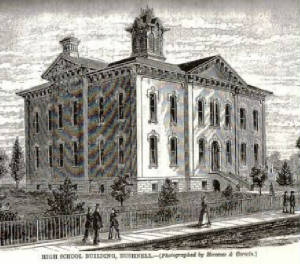
Bushnell High School
A large building with a tree in front of it

Description automatically generated with low confidence
Bushnell HS Bldg 1878
A picture containing text, building, old, government building

Description automatically generated
From “1878 McDonough County History” Submitted by John Bybee

The History of Bushnell High School

Bushnell is located at the intersection of Il. Rt. 9 and Il. Rt. 41 in eastern McDonough County.  The population of 3,221 is spread out nicely around the A,T & SF Railroad.

It is not known when the school system in Bushnell was started.  A consolidation effort between the towns of Bushnell and Prairie City took place in the early 1950s.  The effort was realized in 1952.  A new school was developed and is now called Bushnell-Prairie City High School. The photo above is that of the original Bushnell High School. BPCHS built a new building on the grounds where the above building once stood.

Bushnell High School Quick Facts   

Year opened:                                   late 1800s

Year consolidated with P.C.:           1952

Consolidated School District name: Bushnell-Prairie City School District

Bushnell HS team nickname:           the “Braves”

Bushnell HS team uniform colors:   Blue & Purple

Bushnell HS fight song:                   unavailable

Bushnell HS Building
A picture containing text, old

Description automatically generated

Athletics

There was very limited information regarding the Bushnell High School Braves athletic program available to us on the internet.  We are sure that Bushnell High School offered boys basketball.  Baseball and track were likely offered as well as football.  If you know of other successes and sports offered by Bushnell High School please send us a note.

Football

Our own Beau Spencer provided the following infomration on the BHS grid iron history:

“In 1931, the Braves beat Lewistown 109-0 and Industry 114-0 under Head Coach Golden Babcook.  In the early 1940’s they played a couple NIGHT games under LIGHTS (imagine that, small school football games at night 50!!! years before night baseball at Wrigley Field!!!), but had to travel to Galesburg and Abingdon (yes, Abingdon was one of the first schools in western Illinois to get lights).  Coach Babcook coached from 1925 (1st year) to 1931 (maybe later, don’t have ’32 records), and compiled a 16-0 record in the 1930 &’31 seasons.  The trashing of Industry occurred on October 30th 1931, the Lewistown lashing on November 20th.  In 1931, the Braves outscored their opponents 506-6.  Farmington was the only team that scored against them in a 52-6 game.  Another high score that season was 71-0 win at Colchester. The football program at BHS started sometime between 1916 and 1924.”

Seeking Further Information

We are hopeful someone from Bushnell or a BHS alumnus will be willing to share more information with us regarding the school.  If you have ANY information regarding Bushnell High School or the town of Bushnell please complete a School Submission Form or a Guest Commentary Form.  You may also write us via e-mail at ihsgdwebsite@comcast.net or write to us via mail at:

Illinois HS Glory Days

6439 N. Neva St.

Chicago, Il.    60631


Burnt Prairie High School

Burnt Prairie School
A picture containing outdoor, house, old, residential

Description automatically generated
Burnt Prairie, Illinois

The History of Burnt Prairie High School

Burnt Prairie (population 58!) is located in southeastern Illinois in northwestern White County. In terms of town size Burnt Prairie is #1,297 out 1,313 Illinois towns.  It is actually the 14th smallest incorporated town in Illinois when you consider “ties”.  The main road through town is White County Highway 20.  Interstate Highway 64 sits just north of Burnt Prairie and U.S. Route 45 runs just 4 miles to the west. A branch of the Fred Creek runs to the south of town.  Carmi is located about 12 miles southeast of Burnt Prairie and, more interestingly, Bone Gap is just 20 miles (as the crow flies, naturally) northeast of Burnt Prairie.

The history of the town and its high school has limited information available.  There is only one mention of Burnt Prairie High School on the IHSA web site (www.ihsa.org). The boys basketball team won two District titles with the last one coming in 1940-41.  If you have read many of the write-ups regarding schools in towns of this size, you will probably agree that Burnt Prairie High closed around 1948.

The kids of Burnt Prairie were then sent ot Mill Shoals to continue their high school education.  Mill Shoals later became Mill Prairie High School and was later deactivated as well.  The kids of Burnt Prairie now attend Fairfield High School.

Burnt Prairie High School Quick Facts

Year opened:            late 1800s / early 1900s

Year closed:             1948?

Consolidated to:       Mill Shoals Mills Prairie High School

School nickname:     unavailable

School colors:          Dark Blue & White

School Fight Song:   unavailable

Burnt Prairie Year Book Page
A group of people posing for a photo

Description automatically generated
1945-46 School Year

Athletics

Burnt Prairie High School, as mentioned above, definately offered boys basketball.  Most small schools also offered track and baseball.  We are hopeful a person from the area can fill us in on the missing pieces of the Burnt Prairie High School athleitc successes.

Boys Basketball

The Burnt Prairie High School boys basketball team had two years of District title success.  Unfortunately the team records and coaches names of these and other great BPHS teams are not available.

1936-37        District Champions

1940-41        District Champions

Seeking Your Help

If you have ANY information about Burnt Prairie High School we hope that you would share with this site.  There may not be too many Burnt Prairie Alumni left, so please e-mail us so we can let BPHS memories live on forever.  A photo of the school is eagerly sought.  You can e-mail items to us at ihsgdwebsite@comcast.net.  You can also write to us at:

Illinois HS Glory Days

6439 N. Neva St.

Chicago, Il.   60631

Burnt Prairie Presbyterian Church
A white church with a steeple

Description automatically generated with medium confidence
Burnt Prairie, Illinois