
|
||||||||||||||||||||||||
Blog


Chicago St. Malachy High School
| The History of Chicago St. Malachy High School
Chicago (population 2.8 million) is located along the shores of Lake Michigan as the nation’s third largest city. It grew from a village in 1803 and became incorporated in 1837, then its population boomed thru the second half of the 19th Century with a plethora of immigrants from numerous countries came to the “City of Big Shoulders” to settle and find a way of life. Chicago is accessible from four interstates, several state and US highway routes, by train service that stops at the city’s Union Station along the Chicago River, and thru the air at Midway and O’Hare Airports. As a result, the city is a melting pot of people that make up many cultures which helps define the character of Chicago. |
|||||||
 |
|||||||
|
|||||||
|


Chicago St. Louis Academy
The History of Chicago St. Louis Academy Chicago (population: 2.8 million people) is the third largest city in the United States, located on the shores of Lake Michigan in northeastern Illinois. It was the fastest growing city in the US during the second half of the 19th Century, even with a great fire in 1871 that wiped out a good portion of the city, and by annexing numerous communities such as Woodlawn, Roseland, Englewood, Lake, Rogers Park, Humboldt Park, Forrestville, and Pilsen. Interstates 55, 57, 90, and 94 will take you to the city, along with other highways with state and US designations, train service, and air travel to/from O’Hare International Airport as well as Midway Airport, both of which serve many travelers daily. As the city grew, Chicago became a melting pot of cultures and people with countless nationalities showing representation in the “Windy City.” In doing so, neighborhoods were noted by the country were the immigrants came from. Those folks believed in education and started their own schools, some of which were taught in their native language or run by people that they knew and trusted.
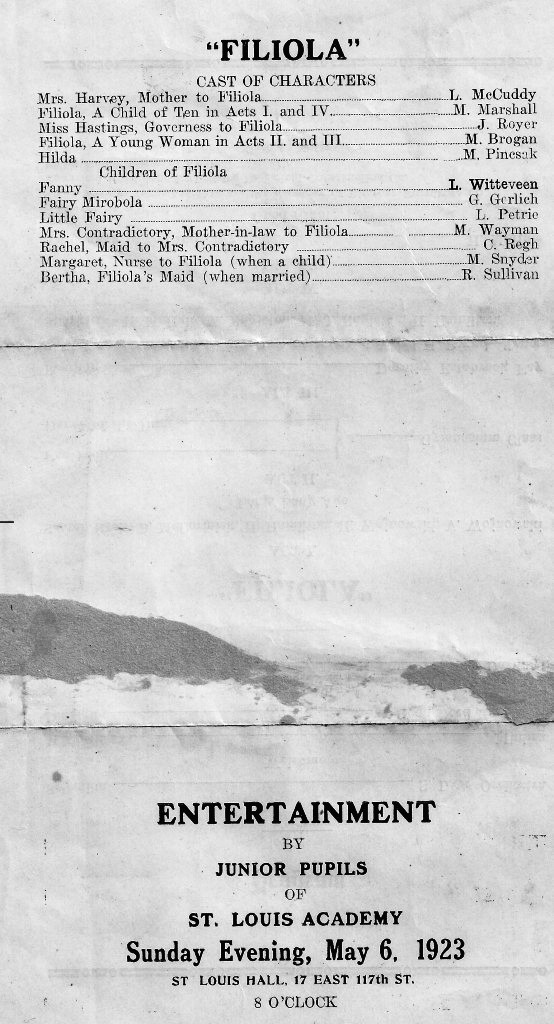
St. Louis Academy for Girls were opened in the Roseland neighborhood on the city’s South Side in 1906 by the Sisters of the Congregation de Notre Dame in a four-story building that was opened in July of that year. The school was intended to be a day and boarding school for grade as well as high school students, but by 1909, the grade school was closed to accomodate a four-year college prep program for the high school students. A two-year commercial course was also started around the same time. The first graduates (two students) received their diplomas in 1910 as the school moved forward. St. Louis continued to serve female students on the South Side as the boarding ended in 1925 in order to create more classrooms and commercial courses were discontinued in 1935. Unfortunately, a 1959 building inspection found the school to be unsafe and forced the school to be closed for good. One hundred twenty-four students made up the last graduating class, with the remainder of the students transferring to Mercy or Mother of Sorrows High Schools. |
|||||||||||||||||||
 |
|||||||||||||||||||
|
|||||||||||||||||||
|
|||||||||||||||||||




Chicago St. Joseph High School “Condors”
|
|||||||||


The History of Chicago St. Joseph High School
Chicago (population 2.8 million) is located in far northeastern Illinois and is the county seat of Cook County. Lake Michigan serves as the town’s eastern border. Several highways and Illinois Routes will lead you to and from “the big city.” Chicago was organized as a small town in 1832 and was officially incorporated in 1837. Chicago has been the scene of many dramas including “The Great Chicago Fire” and the violent mobster action of the 1920s and 1930s, which immortalized criminals such as Al “Scarface” Capone. Today, Chicago is one of the top tourist attractions in the United States and is the country’s third largest city.
An extensive history of the St. Joseph parish, one of Chicago’s many catholic parishes, can be read at the web address of http://www.pgsa.org/ArchChiPolPar/StJosephChi.htm. The article, in summary, states the following:
St. Joseph Catholic Parish was established in 1886. The church building was constructed and dedicated at 4800 South Hermitage on Chicago’s southside. A parish grammar school was established in the late 1880s and early 1890s. The school began a one-year “commercial department” for kids who graduated grammar school in 1912. The grammar school became so populated that the commercial school was disbanded in 1918 to provide more room for the grammar school students.
It was in 1938 that St. Joseph opened a four-year co-educational high school with a commercial course added two years later. The high school began with an enrollment of 90 students but swelled to an enrollment of 300 students with the addition of Sacred Heart High School (which was added to the St. Joseph school) in 1941. This increase also caused the building of a new high school building in 1941 as well.
St. Joseph High School remained a steady force in the neighborhood for nearly 60 years. Enrollment at the high school in 1978 was 433 students. Slowly, the changing neighborhood led to dwindling enrollments at the high school and grade school levels. It was in the mid 1990’s that concerns of being able to keep the high school open arose. In 1996, those concerns were put to rest when the decision was made to close St. Joseph High School.
The fate of the St. Joseph High School building is a good one, still in use today as evidenced by the photo at the top of the page.
St. Joseph High School Quick Facts
Year opened: 1938
Year closed: 1996
St. Joseph HS team nickname: the “Condors”
St. Joseph HS team colors: Blue & Gold
St. Joseph HS fight song: Oh Cheer It St. Joseph High!
Submitted by John Piotrowski
Oh Cheer it, Revere it, St. Joseph High,
Together, let’s raise a rousing cry!
United in effort, always true!
St. Joseph High, ALL HAIL TO YOU!
RAH! RAH! RAH!!
St. Joseph High, for you we’ll dare and do,
Pledge to truth and honor,
‘Neath the GOLD and BLUE!
Loyal sons and daughters,
We sing on for your fame!
Till the echoes ring, we’ll sing,
St. Joseph High, ALL HAIL TO YOU!
RAH1 RAH! RAH!!!

ATHLETICS Chicago St. Joseph High School should not be confused with its namesake in Westchester. Chicago St. Joseph offered such sports as football, basketball, track, and baseball for its boys at one time or another. It is likely the girls participated in volleyball, basketball, track, and softball. We currently have no information regarding the overall athletic program of St. Joseph High School. We are searching for any of this information including the school’s fight song, coach’s names, seasonal records, and individual accomplishments. If you have this information, please contact us via the means at the bottom of this page. BOYS BASKETBALL The boys definitely competed in basketball. Unfortunately the only mention of the program on the IHSA website (www.ihsa.org) has a negative overtone. Chicago St. Benedict scored 81 points on against St. Joe in the first half of a game on January 7, 1966. This total is tied for the sixth-highest amount of points scored in one half. We know that St. Joseph probably had some great moments in its athletic history. Please contact us if you have any of this information to share. TO PROVIDE INFORMATION ON CHICAGO ST. JOSEPH HIGH SCHOOL: Contact us in the following ways: 1) Complete a “School Submission Form” on line. (click here) 2) Write to us via e-mail at ihsgdwebsite@comcast.net. 3) Send information to us at: IHSGD Website 6439 N. Neva St. Chicago, Il. 60631 |
||||||||||||
 |
||||||||||||
 |
||||||||||||
 |
||||||||||||


Chicago St. James High School
| The History of Chicago St. James High School
Chicago (population 2.8 million) is located in far northeastern Illinois in the center of Cook County. Lake Michigan (one of the “Great Lakes”) serves as Chicago’s eastern border. Chicago is one of the largest cities in the United States and boasts of several museums making it a fantastic place to visit for history buffs. It is also home to several professional sports teams, most notably the Bears, Bulls, Cubs, and White Sox. Chicago has strived to provide a good education for its children. High schools have been built in Chicago since the early 1850’s. In addtion to the many high schools that have been established over the years, there are those which have went through name changes and identity makeovers. |
|||||||
 |
|||||||
|
|||||||
|


Chicago St. Gregory High School “Greyhounds”
The History of Chicago St. Gregory High School
Chicago (population: 2.8 million people) is the third largest city in the United States, located on the shores of Lake Michigan in northeastern Illinois. It was the fastest growing city in the US during the second half of the 19th Century, even with a great fire in 1871 that wiped out a good portion of the city. Chicago also grew by annexing numerous communities such as Woodlawn, Roseland, Englewood, Lake, Rogers Park, Humboldt Park, Forrestville, and Pilsen who are all titled “neighborhoods” in the city limits of Chicago. Interstates 55, 57, 90, and 94 will take you to the city, along with other highways with state and US designations. Train service, and air travel to/from O’Hare International Airport as well as Midway Airport, both of which serve many travelers daily are also transportation means to and from the city. As the city grew, Chicago became a melting pot of cultures and people with countless nationalities showing representation in the “Windy City.” Chicago St. Gregory the Great High School was started in 1938. The school is named after Gregory the Great who lived during the 6th century. He builit many monestaries on his land and was a true supporter of the God and church. He is known as the patron saint of music. St. Gregory the Great died in 604AD. For more information regarding St. Gregory the Great check out this web address: http://www.stgregory.org/st-gregory-the-great/ Chicago St. Gregory the Great High School was built on Chicago’s north side at 1677 W. Bryn Mawr Avenue. A Chicago Tribune newspaper article states the school had some “glory days” of its own in enrollment, In the 1980s enrollment was steady at above 500 students. As recently as the early 2000s enrollment had leveled at around 300. However recent years brought a greater decline to the point where there were just above 100 students enrolled for the past few years. Financial strife and enrollment led to the decision to close the school at the end of the 2012-13 school year. The Tribune article states that at one time nearly every Catholic parish in Chicago had a high school. At one time there over 100 Catholic high schools in the area, today there are about 40. The fate of the St Gregory High School building is needed. If you have any further information on the school’s history please contact us at ihsgdwebsite@comcast.net .
Chicago St. Gregory High School Quick Facts Year opened: 1938 Year closed: 2013 Consolidated to: (closed) Address: 1677 W. Bryn Mawr Ave. Chicago St. Gregory HS mascot: “Greyhounds” Chicago St. Gregory HS team colors: Royal Blue, Red, Gray, & White Chicago St. Gregory HS fight song: (information needed) |
|||||||||||||||||||
 |
|||||||||||||||||||
|
|||||||||||||||||||
|
|
|||||||||||||||||||


Chicago St. George School for Girls
The History of St. George’s School for Girls Chicago (population: 2.8 million) is located on the shores of Lake Michigan, and is the third largest city in the United States. Various interstate, state, & US highways travel thru the “Windy City” along with several railroad carriers. O’Hare International Airport is one of the busiest terminals in the world, and handles a great deal of air traffic on a daily basis. The Chicago and Des Plaines Rivers still provide an outlet for water traffic if chosen by those wish to travel by that mode. “The City of Big Shoulders” was founded in 1803 as Fort Dearborn, then grew slowly until it was recognized as a city in 1837. Although it may have suffered a setback in 1871 to the Great Chicago Fire, the city pulled itself up by its own bootstraps to rebuild, gaining many immigrants from various European countries and hosted the Columbian Exposition in 1893. By then, Chicago had grown even more to the point that it became the fastest growing city in the US during the second half of the 19th Century. St. George School for Girls was opened in 1918 by its founder, George Williams. The school’s purpose was to educate at the elementary level and do so by having a facility that embraced the heritage of the Hyde Park neighborhood. The school expanded to a high school division and eventually took in boarders around World War II, when about 300 students lived on campus. St. George was initially located at 910 Lawerance Avenue on the city’s North Side, but moved in 1921 to 4545 Drexel because of increased enrollment. The high school opened at that time, but it became too large to handle and returned to an elementary school in 1938, according to the archives of the Hyde Park Herald. In 1934, Anne Tyskling arrived at the school as a teacher, and assumed the director’s role two years later to guide the future of the school. After closing the high school down and getting thru World War II, St. George went thru a period of consternation which included having to move the school, financial crisis, and the threat of closing the school. Mrs. Tyskling did what she could to keep the school open, including having to move to the Rodfei Zedek Temple on East 54th Place. Another hallmark moment that St. George endured was in 1952 when the school was threatened with eviction due to admitting a Hindu child into the school. For those who lived around the school, the child was thought to be African-American as the city of Chicago was experiencing an influx of people from the southern part of the United States, and since the school was located in a neighborhood where the neighbors objected nor cared, St. George rose above the situation by becoming a model to other schools in how they accepted all children, regardless of their race, creed, and color. The school survived the issues and relocated again to 4810 Ellis in a building that was purchased by Tyskling, then grew to 145 students within a matter of years, at which time St. George and Harvard School for Boys began talks to merge their schools together. The Board of Directors for St. George agreed to buy Harvard School and bring together students from K-12 in an intergrated setting, completing its mission in time for the 1962-63 school year |
|||||||||||||||||||
 |
|||||||||||||||||||
|
|||||||||||||||||||
|
|||||||||||||||||||


Chicago St. Gabriel High School
|
|||||||||


The History of Chicago St. Gabriel High School
Chicago (population: 2.8 million people) is the third largest city in the United States, located on the shores of Lake Michigan in northeastern Illinois. It was the fastest growing city in the US during the second half of the 19th Century, even with a great fire in 1871 that wiped out a good portion of the city, and by annexing numerous communities such as Woodlawn, Roseland, Englewood, Lake, Rogers Park, Humboldt Park, Forrestville, and Pilsen.
Interstates 55, 57, 90, and 94 will take you to the city, along with other highways with state and US designations, train service, and air travel to/from O’Hare International Airport as well as Midway Airport, both of which serve many travelers daily. As the city grew, Chicago became a melting pot of cultures and people with countless nationalities showing representation in the “Windy City.” In doing so, neighborhoods were noted by the country were the immigrants came from. Those folks believed in education and started their own schools, some of which were taught in their native language or run by people that they knew and trusted.

|
Opened in 1895 as a parish school, St. Gabriel High School opened with 28 co-ed students. The Sisters of Mercy were in charge of the school and built another building on Chicago’s South side at the corner fo 45th and Wallace Streets in 1905.
St. Gabriel was a “free” school, meaning that no tuition payments were accepted, except for music lessons. The school closed as an academic institution in 1924 when it merged with four other small schools in the city (St. James, St. Ita, St. Patrick from the Southeast side, & some female students from St. Elizabeth) to form Mercy High School. The commercial department remained open until 1969. At the time of the 1924 closing, there were 600 alumni from St. Gabriel, most of which entered religious life. |
 |
 |
 |
| FACTS ABOUT CHICAGO ST. GABRIEL HIGH SCHOOL
Year opened: 1895 New building opened: 1905 Year academic dept. closed: 1924 Year commercial dept. closed: 1969 WE’RE READY AND WAITING…. to find out more from you, and other folks who may have some information to pass along about St. Gabriel’s history. Photos of the school, names of notable students, memories, and much more are welcome. Please contact us at dr.veeman@gmail.com or thru the mail at: Illinois High School Glory Days 6439 North Neva Chicago, IL 60631 |
Chicago St. Elizabeth High School “Ironmen”
The History of Chicago St. Elizabeth High School Chicago (population 2.8 million) is in northeastern Illinois in eastern Cook County. Lake Michigan, along with the Chicago and Des Plaines Rivers are the main waterways in the city. Interstates 55, 57, 90, & 94 will all lead you to the “Windy City.” From what started as a small village in the early 1800’s along the banks of Lake Michigan, Chicago has grown to the nation’s third largest city and one of the most famous places in the world, as the result of an ethnically diverse community that adopted the city. St. Elizabeth High School first opened its doors to female students only in 1890 on 41st Street in Chicago where Mercy Academy was located. The Sisters of Mercy were in charge of the school, which was part of a parish. A commerical course of study was added in 1911 as the enrollment grew to 221 in the fall of 1914, only to drop to 175 six years later. During this time, the city of Chicago experienced a wave of African-Americans moving from the South to the city for employment, either bringing families with them or starting them after settling down. In response to these changes, the school’s racial makeup became African-American in 1922 with the Sisters of the Blessed Sacrament instructing both boys and girls, while the Caucasians moved into another building. Two years later, the St. Elizabeth girls at Mercy were part of a consolidation into a new school called Mercy High School as the result of restructuring of the Archdiocese high schools by George Cardinal Mundelein, and became possibly one of the first efforts of desegregation in a Chicago Catholic high school. With the influx of students coming from St. Patrick’s on the southeast side of town, St. Ita’s from the north, St. James from the northwest, and St. Gabriel from the south, Mercy was forced to build a new facility that would open in 1926. Due to the increase in enrollment, the remaining students from St. Elizabeth moved into the former Mercy Academy building in 1926, then into the LaSalle University Extension building at Michigan Avenue and 41st Street in 1944. That building offered plenty of space for 11 classrooms, two labs, cafeteria, library, assembly hall, and office space. But it was also the home to the Swift Club, a social gathering hall that housed a ballroom and club rooms, which became alive after 2 o’clock in the afternoon each day. St. Elizabeth stayed co-ed until 1962 when the school went back to an all-female enrollment and Hales Franciscan High School opened as an all-boys’ school. Unfortunately, the school was not able to go on much longer as it closed after the 1966-67 school year. Only 162 students and five faculty members were there during that final school year, which closed on account of a lack of teaching sisters and financial problems. The remaining sophomores and juniors were transferred to Loretto Academy in the Woodlawn neighborhood or to other schools closer to students’ homes. The St. Elizabeth building is no longer still standing, having been torn down years ago. In its place is a modern version of St. Elizabeth’s Church, which was constructed in 1988-89, and serves the African-American population of Chicago’s South Side. Information about the former high school building is welcomed at the addresses listed below. An excellent time-line regarding the history of St. Elizabeth’s parish and school can be viewed at the web address of http://www.stelizabethchicago.com/ParishHistory.html. FACTS ABOUT CHICAGO ST. ELIZABETH HIGH SCHOOL Year opened as all-girls’ school: 1890 Year school desegregated & allowed boys: 1922 Year it returned to all-girls’ school: 1962 Year closed: 1967 School nickname: “Ironmen” School colors: Blue & Gold School song (partial listing, thanks for former student Rosalie Sherrill) Saint Elizabeth, Saint Elizabeth We are proud to call you our own Your patience, your guidance Your thought resemble our very own…. |
||||||||||||
 |
||||||||||||
|
||||||||||||
|
||||||||||||


Chicago St. Dominic High School
| The History of Chicago St. Dominic High School
Chicago (population 2.8 million) is located in northeastern Illinois in eastern Cook County. Lake Michigan, the Chicago and Des Plaines Rivers are the main waterways to and from town. Interstates 90, 94, 55, and 57 will all lead you to the “Windy City,” as will numerous US and state routes, which at one time included the legendary Route 66. From what started as a small village in the early 1800’s, Chicago has grown to the nation’s third largest city and one of the most famous places in the world. |
|||||||
 |
|||||||
|
|||||||
|


